 ultimate-guide
Home Buying Process in Central Florida: 2026 Guide
Table of Contents
- Understanding the Home Buying Process
- Assess Your Finances and Create a Home-Buying Budget
- First-Time Home Buyer Checklist: Credit, Down Payment, and Pre-Approval
- How Long Does It Take to Buy a House
- Buying a Home with Student Loans: What Lenders Look For
- Find a Real Estate Agent and Search Local Markets
- Make an Offer, Inspect, and Navigate Contingencies
- Closing: Appraisal, Underwriting, Title Search, and Final Walkthrough
- Frequently Asked Questions
Last Updated: October 11, 2026
Understanding the Home Buying Process
The home buying process in central in Florida follows a structured path from financial preparation through closing, though the timeline and complexity depend on your circumstances and market conditions.
Most first-time buyers underestimate the moving parts involved. You'll assess finances, check credit, save for a down payment, get pre-approved, find an agent, search the market, make an offer, navigate inspections, complete underwriting, and close.
The home buying process in central in Florida typically takes 30-45 days from offer acceptance to closing, though pre-approval and searching can add months to your overall timeline.
Assess Your Finances and Create a Home-Buying Budget
Before searching, know what you can afford. Your budget depends on down payment savings, monthly income, and existing debt. Lenders use a debt-to-income ratio to determine loan amount, this ratio is your biggest constraint on purchasing power.
Calculate your gross monthly income and all monthly debt payments. Lenders typically allow a debt-to-income ratio up to 43 percent, meaning total monthly debt plus your new mortgage cannot exceed 43 percent of gross income.
A larger down payment means lower monthly payments and better rates. Most conventional loans require 3 percent minimum down, but you'll pay PMI if below 20 percent.
First-Time Home Buyer Checklist: Credit, Down Payment, and Pre-Approval
Check and Improve Your Credit Score
Your credit score is the first thing a lender examines. Most conventional loans require a minimum 620; FHA loans accept 580.
Check your credit report from all three bureaus at least 30 days before applying. Look for errors, late payments, collections, or fraud. Dispute errors immediately. Pay down credit card balances and avoid new debt inquiries in the months before application.
Lenders pull your credit during pre-qualification and underwriting. Multiple hard inquiries within 14 days count as one for mortgage shopping, so timing lender contacts matters.
How Much Down Payment for a $300,000 House
For a $300,000 home purchase, your down payment options break down like this:
- 3 percent down: $9,000 (conventional loan, requires PMI)
- 5 percent down: $15,000 (conventional loan, requires PMI)
- 10 percent down: $30,000 (conventional loan, requires PMI)
- 20 percent down: $60,000 (conventional loan, no PMI)
The $300,000 purchase price is common in central in Florida. Beyond your down payment, budget $6,000 to $15,000 for closing costs, inspections, and appraisals.
Many first-time buyers overlook closing costs. Asking the seller to cover them can help, though it may reduce negotiating power on price.
Get Pre-Qualified and Pre-Approved
Pre-qualification is informal and carries no weight with sellers. Pre-approval is formal: a lender reviews documents, pulls credit, and issues a written commitment. Pre-approval is what sellers take seriously.
Gather recent pay stubs, W-2s (2 years), tax returns (2 years), bank statements (2 months), proof of employment, and a list of all debts. The lender verifies income, assets, employment, and checks for fraud in 3-5 business days. Your pre-approval letter shows sellers you're a serious, qualified buyer.
How Long Does It Take to Buy a House
The home buying process in central in Florida timeline varies. Pre-approval takes 3-5 days. Searching and making an offer can take weeks to months. Once accepted, you have 30-45 days until closing.
Post-offer timeline: Days 1-3 inspection, Days 3-7 repair requests, Days 7-14 appraisal, Days 14-30 underwriting, Days 30-45 title search and closing. Appraisal delays, underwriting requests, or title issues can extend this. Flood zone determinations and wind mitigation inspections are common in central in Florida and can add 5-10 days.
Buying a Home with Student Loans: What Lenders Look For
Student loans affect your debt-to-income ratio and borrowing power. Lenders count payments as monthly debt even in deferment. A $300 monthly payment reduces borrowing capacity by roughly $70,000 to $100,000 on a conventional loan.
Lenders use your actual payment or estimate 0.5 percent of outstanding balance if in deferment. Consolidating or refinancing before applying can lower payments and improve your ratio, but refinancing federal loans removes federal protections.
Provide statements showing current balance, monthly payment, and loan servicer. Shop multiple lenders if you carry significant student debt, as flexibility varies.
Find a Real Estate Agent and Search Local Markets
A real estate agent who understands central in Florida markets is essential. The right agent knows neighborhood trends, school ratings, flood zones, and insurance costs.
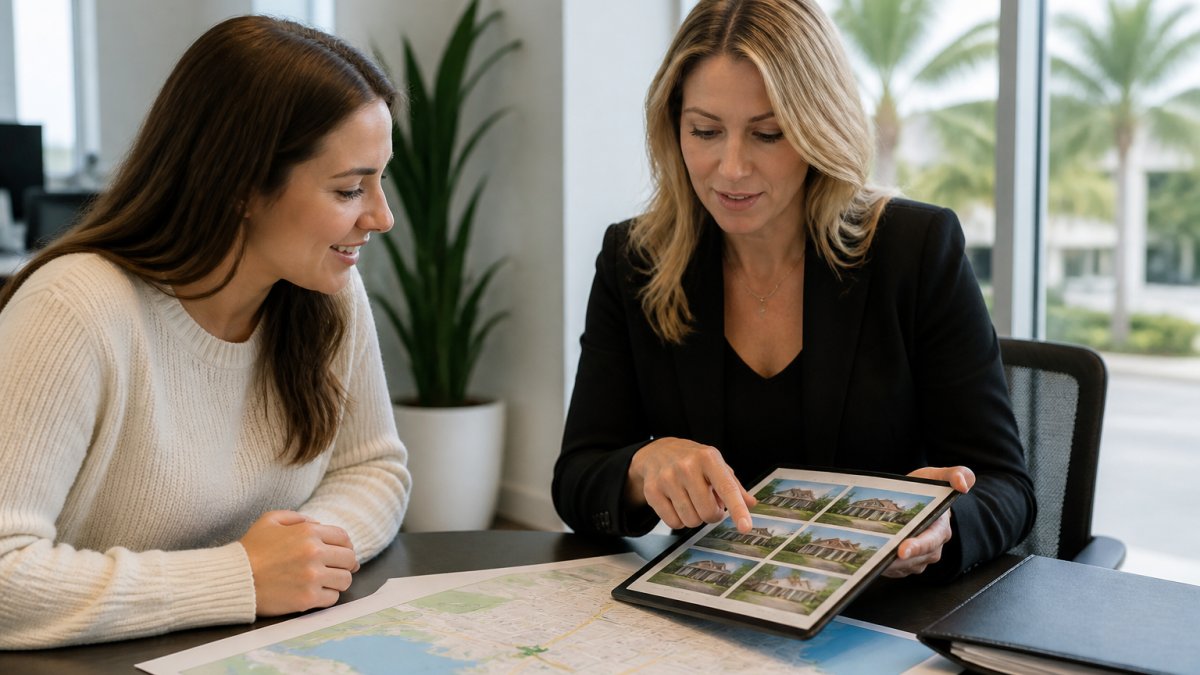
Your agent should explain whether it's a buyer's market with room to negotiate or a seller's market with bidding wars. In central in Florida, conditions vary by neighborhood and season.
Most agents in central in Florida use MLS (Multiple Listing Service) search tools to find homes matching your criteria.
Choosing Your Neighborhoods and Communities
Central in Florida offers diverse neighborhoods with different character, price points, and amenities. Lake Nona attracts families seeking newer construction and master-planned community amenities. Windermere appeals to buyers wanting larger lots and more established neighborhoods. Hunters Creek offers proximity to theme parks and employment centers. Orlando's downtown neighborhoods attract buyers seeking walkability and urban living.
Research schools, commute times, flood zones, and property tax rates for each neighborhood you're considering. These factors dramatically affect your long-term satisfaction and resale value.
Understanding Local Property Taxes and Insurance in Central Florida
Property taxes in central in Florida vary by county and neighborhood. Orange County and Osceola County have different assessment methods and millage rates. A $300,000 home might have annual property taxes of $3,500 in one area and $4,200 in another.
Homeowners insurance is more complex in central in Florida due to hurricane risk and flood zones. Standard homeowners insurance covers wind and hail but may exclude flood.
Ask your lender and insurance agent for estimates before making an offer. Insurance and property tax costs are part of your true monthly payment and affect your debt-to-income ratio during underwriting.
Make an Offer, Inspect, and Navigate Contingencies
Once you find a home, your agent helps you research comparable sales, assess market conditions, and determine an offer price. In central in Florida, offers typically include an earnest money deposit (1-3 percent of purchase price), inspection contingency, appraisal contingency, and financing contingency.
Your offer should specify the inspection period (typically 7-10 days), appraisal contingency (protects you if the home appraises for less than your offer price), and financing contingency (allows you to back out if you don't get approved). These contingencies protect you but also signal to sellers that your offer carries conditions.
Home Inspection and Roof Concerns in Florida
A home inspection is non-negotiable. The inspector examines the roof, foundation, plumbing, electrical, HVAC, and structural integrity. In central in Florida, roof condition is critical.
If the inspection reveals roof issues, you have options: request the seller make repairs, request a credit toward repairs, or renegotiate the price. Roof replacement costs $8,000-$15,000+, so this negotiation matters.
Document all inspection findings in writing. Provide the seller with a detailed repair request and ask for proof of completed work or a credit. Don't assume verbal agreements, get everything in writing before closing.
Closing: Appraisal, Underwriting, Title Search, and Final Walkthrough
After your offer is accepted, the appraisal is ordered. The appraiser determines the home's market value independent of your purchase price.
Underwriting is the lender's detailed review of your finances, the property, and the loan. The underwriter verifies income, employment, assets, and credit.
A title search reveals any claims against the property. Liens, judgments, or easements must be resolved before closing.
Your final walkthrough happens 24 hours before closing.
Once documents are recorded and funds clear, you receive the keys and own the home.
Buying a home in central in Florida involves coordinating finances, paperwork, inspections, and negotiations across 30-45 days. Our team combines deep local expertise with commitment to ethics and client satisfaction. HUD's home buying resources provide federal guidance on the process, while the National Association of Realtors maintains current market trends and buyer education materials.
Frequently Asked Questions
How much down payment do I need for a $300,000 house?
Down payment requirements typically range from 3% to 20% of the purchase price. For a $300,000 home, that's $9,000 to $60,000. Conventional loans often require 5-20% down, while FHA loans may accept 3.5% down ($10,500). Your credit score, debt-to-income ratio, and loan type determine your exact requirement. Lenders will provide a loan estimate showing your specific down payment obligation after pre-qualification.
How long does it take to buy a house in Central Florida?
The typical home buying process takes 30-45 days from offer acceptance to closing. This includes the inspection period (usually 7-10 days), appraisal (5-7 days), underwriting (5-10 days), and title search (3-5 days). In Central Florida's competitive market, some transactions close in 21 days with cash offers or new construction. Delays occur when inspections reveal issues, appraisals come in low, or underwriting requests additional financial documents.
Can you buy a house with student loans?
Yes, you can buy a house with student loans, but lenders scrutinize your debt-to-income ratio closely. Your monthly student loan payment counts against your borrowing capacity. A typical lender allows a debt-to-income ratio up to 43-50%, meaning your total monthly debt (including the new mortgage) cannot exceed that percentage of your gross income. Income-driven repayment plans can lower your calculated payment, improving your qualification. Discuss your student loan situation with your lender during pre-approval.
What should I include on my first-time home buyer checklist?
Your checklist should cover: checking your credit report and score, saving for a down payment, getting pre-approved for a mortgage, researching neighborhoods and schools, securing a real estate agent, viewing properties, making an offer, scheduling a home inspection, reviewing the appraisal, finalizing your mortgage, obtaining homeowners insurance, conducting a final walkthrough, and reviewing closing disclosure documents. In Central Florida, also budget for flood insurance verification, HOA documents, and property tax estimates specific to your county.
What are the typical costs beyond the down payment when buying a home?
Closing costs typically range from 2-5% of the purchase price and include loan origination fees, appraisal, title search and insurance, homeowners insurance, property taxes, HOA fees, and attorney fees. For a $300,000 home, expect $6,000-$15,000 in closing costs. Central Florida buyers should also budget for flood zone verification, wind mitigation inspections (important for insurance), and potential HOA reserves. Request a loan estimate early to understand your exact costs.
How do I know which Central Florida neighborhood is right for my family?
Evaluate neighborhoods by visiting during different times of day, researching school ratings through the Florida Department of Education, checking property tax rates by county (Orange and Osceola vary), reviewing crime statistics, and understanding flood zone maps and insurance requirements. Visit local parks, shops, and community centers. Speak with current residents. Consider commute times to your workplace and proximity to theme parks or sports venues if relevant. A local real estate agent with deep community knowledge can provide insights into school quality, neighborhood trends, and family amenities you won't find online.
What happens if the home inspection reveals problems in Central Florida?
After inspection, you can request repairs, ask the seller for a credit toward repairs, renegotiate the price, or walk away (if your contract includes an inspection contingency). In Central Florida, roof condition is critical, many lenders and insurers scrutinize roofs over 10-12 years old due to storm risk. If your lender flags roof concerns, you may need a roof certification or replacement estimate. Discuss findings with your lender and insurance agent immediately, as some issues can affect loan approval or insurance eligibility.
What's the difference between pre-qualification and pre-approval?
Pre-qualification is an informal estimate based on information you provide; it's not verified and carries no weight with sellers. Pre-approval involves a formal application, credit check, and verification of income and assets. Pre-approval is binding (subject to final underwriting) and shows sellers you're a serious buyer. In competitive Central Florida markets, pre-approval is essential for making competitive offers. Pre-approval is valid for 60-90 days; you'll need to renew it if your offer isn't accepted within that window.